The system architecture for trusted enterprise AI agents
Four capability layers that provide enterprise data semantics, AI agent governance, runtime compliance controls, and operational oversight — everything required to deploy AI agents safely in production environments.
ARCHITECTURE OVERVIEW
Four layers. One trusted stack.
Each layer of the Superbo Agentic Stack addresses a specific requirement for deploying enterprise AI agents safely at scale.
L1
Resource Abstraction
SYSTEM ACCESS
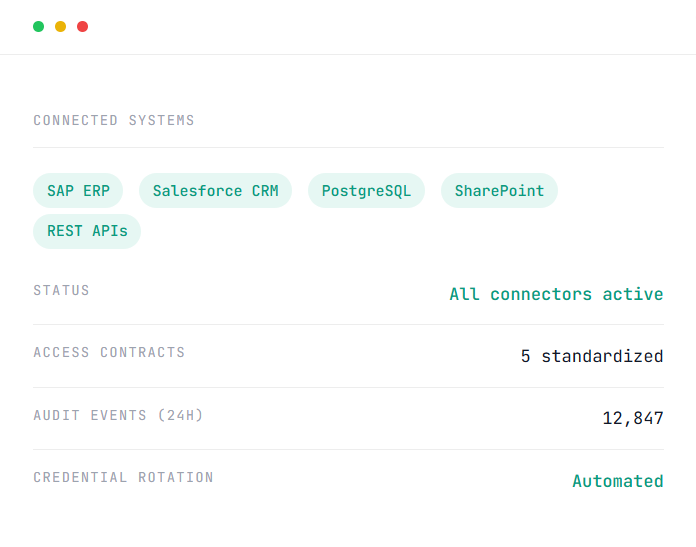
Provides secure, standardized access to enterprise systems for AI agents. Without this layer, agents cannot interact with the systems where enterprise data lives and work gets done.
L2
CORE INNOVATION
Ground Zero
KNOWLEDGE FOUNDATION
The core innovation of the Superbo Agentic Stack. A machine-readable knowledge layer that makes enterprise data interpretable by AI agents. Semantic mapping, data lineage, conflict resolution, and policy enforcement.
L3
Agent Orchestration
GOVERNED EXECUTION
Manages how AI agents plan, execute, and coordinate within enterprise workflows. This is where governance is enforced during execution — not observed after the fact.
L4
AI Agents & Solutions
VERTICAL AGENTS
Domain-specific AI agents for high-value enterprise workflows. Superbo's own agents and third-party agents operate side by side under a unified trust, compliance, and traceability framework.
ARCHITECTURE ANALYSIS
The Superbo Stack in action
LAYER 1
Resource Abstraction
Provides secure, standardized access to enterprise systems for AI agents. Without this layer, agents cannot interact with the systems where enterprise data lives and work gets done.
Connectors to ERP, CRM, databases, document stores, and APIs
Standardized access contracts per system — consistent interfaces regardless of underlying technology
Secure system boundaries and credential management — agents only access what they're authorized to
Access logging and activity audit trails for every system interaction
LAYER 2
Ground Zero Knowledge Foundation
Ground Zero transforms raw enterprise data into a trusted, machine-readable knowledge layer that AI agents can reason over. Unlike traditional data catalogs or governance tools that serve human users, Ground Zero is purpose-built to make enterprise data interpretable by AI agents at runtime.
Enterprise data dictionary with machine-readable definitions, not documentation for humans, but structured knowledge for agents
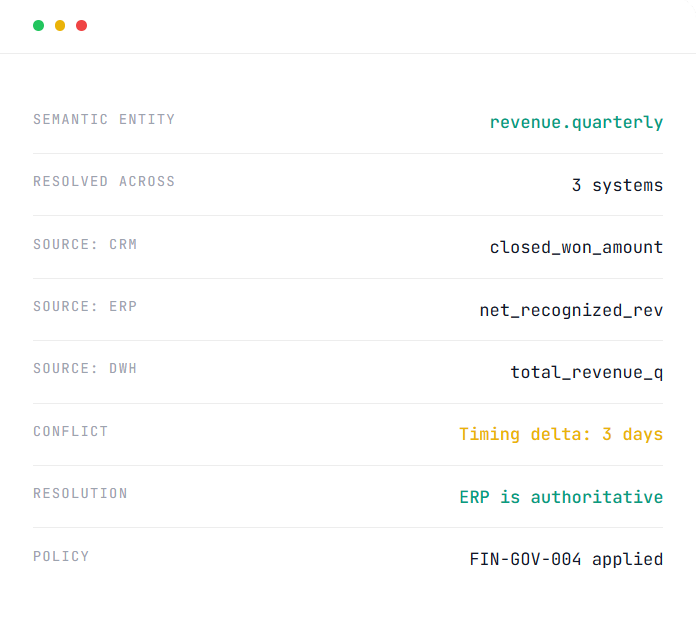
Semantic concept mapping across systems and domains, resolving what "revenue" means in the CRM vs. the ERP vs. the data warehouse
Data lineage and provenance tracking, every data point traceable to its source system and transformation history
Policy enforcement and controlled data access, governance rules applied at the data layer, not bolted on after
Conflict resolution across overlapping data sources. When systems disagree, Ground Zero provides the authoritative interpretation
LAYER 3
Agent Orchestration
Manages how AI agents plan, execute, and coordinate within enterprise workflows. This is where governance is enforced during execution — not observed after the fact.
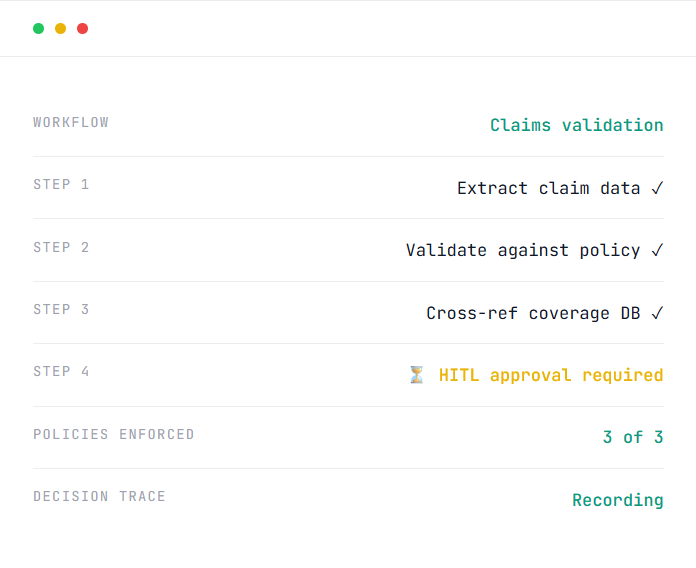
Reasoning and planning workflows. Agents decompose complex tasks into governed execution steps
Multi-agent coordination and task delegation. Specialized agents collaborating under unified governance
Policy guardrails enforced at runtime, not post-hoc review, but real-time constraint enforcement during agent execution
Decision trace recording. Every reasoning step captured for auditability and investigation
Human-in-the-loop oversight. Configurable approval workflows and escalation paths for high-stakes decisions
Monitoring, alerts, and performance tracking across all deployed agents
LAYER 4
AI Agents & Solutions
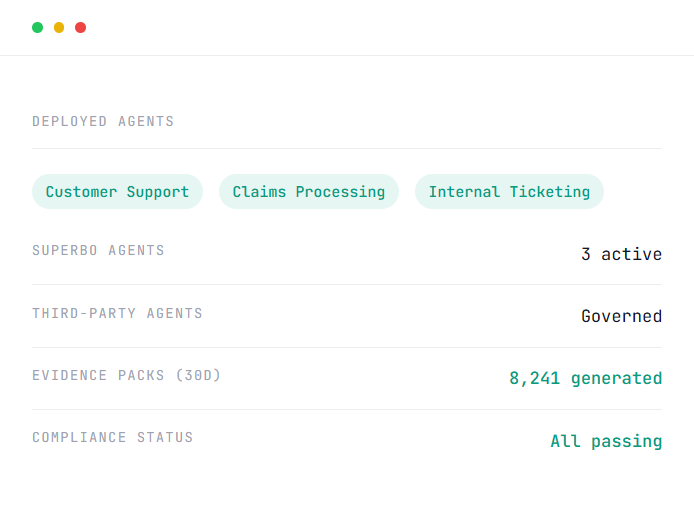
Domain-specific AI agents designed for high-value enterprise workflows. Superbo's own agents and third-party agents operate side by side under a unified trust, compliance, and traceability framework.
Operational decision support agents, data-driven recommendations with full traceability
Customer support agents live in production in telco and healthcare
Third-party agent interoperability. Orchestrate and govern external agents under the same trust framework
Evidence Packs — AI audit trail
Every AI agent action produces an audit-ready Evidence Pack
Generated automatically at runtime. No additional configuration. Not an add-on. A foundational capability embedded in every layer of the Superbo Agentic Stack.
Resolved Concepts
Enterprise data entities used by the agent, resolved via Ground Zero
Source Data
Referenced data and systems. Full provenance for every input
Applied Policies
Constraints and governance rules enforced during execution
Decision Trace
Step-by-step reasoning path from input to output
Audit Identifiers
Unique IDs and timestamps for every action — ready for regulatory review
Explain
AI decisions to internal stakeholders and regulators
Investigate
Unexpected agent behavior or output errors
Demonstrate
Compliance with EU AI Act, GDPR, and ISO 42001
Prove
Operational accountability across AI-driven workflows
Why Superbo Agentic Stack
What makes this architecture different
The Superbo Agentic Stack occupies a layer that adjacent categories / agent frameworks, data governance tools and AI observability platforms do not fully control.
Governance embedded in runtime
Most AI governance tools observe and report after the fact. Superbo enforces policies during agent execution and generates Evidence Packs as a native output of every action — not a post-hoc audit.
Data semantics purpose-built for AI agents
Traditional data governance tools serve human users — catalogs, documentation, lineage views. Ground Zero makes enterprise data machine-readable and interpretable by AI agents at runtime.
Trust built in, not bolted on
LangChain, n8n, and CrewAI help build and run agents but leave enterprise data semantics, compliance enforcement, and audit-ready evidence as separate problems. Superbo provides these as integrated stack capabilities.
Cross-system, not single-ecosystem
Salesforce, SAP, and ServiceNow embed AI within their own boundaries. Superbo's agents operate across enterprise systems — ERP, CRM, databases, APIs — under a unified trust framework.
Evidence-generating by default
Every AI action produces audit-ready Evidence Packs — traceable, structured records of data inputs, reasoning steps, applied policies, and outputs. No other architecture produces this natively.
See the stack in action
Book a discovery call and we'll show you a tailored agent simulation
We'll map your use case, data landscape, and compliance requirements — then demonstrate how the Superbo Agentic Stack delivers trusted AI agents for your specific workflows.